
This is an English translation of the original article published by Zerkalo.
Most Belarusians know Michael Sender as the man who turned Kufar into the country’s largest classified advertising platform. Far fewer know that he also co-created the anonymous music project UltraВожык and recently interpreted for Nobel Peace Prize laureate Ales Bialiatski during a meeting at the Swedish Parliament. Zerkalo spoke to Michael about building Kufar, whose advertising was once accused of promoting same-sex relationships; why he turned down a role in Belarus’s democratic movement; why he blogged in the guise of an alien; and why he believes humanity is approaching collapse.

Michael Sender describes his life as “unusually cosmopolitan.” Born in the Byelorussian Soviet Socialist Republic, he spent several years in Nigeria with his parents in the late 1980s before returning to what had by then become independent Belarus. In the late 1990s, while still a teenager, he moved to Sweden.
Although Michael had firmly established himself in Scandinavia, gaining Swedish citizenship and graduating from the Stockholm School of Economics, he returned to Belarus in 2013. He had been invited to head a new venture in the country: Kufar, a classified advertising platform owned by the Scandinavian media group Schibsted.
“It was a very interesting proposition – to run a marketplace in Belarus. I love Belarus. It is my homeland, and I like it there despite all its flaws. The situation then was not what it is now. It was not North Korea. You could still live there, particularly if you were single, had no children and did not have to contend with kindergartens, schools, state-run clinics and so on. Life there was actually quite convenient at the time,” Michael recalls.
His return to his homeland was not without bureaucratic absurdities. Although he lived in Belarus for almost five years and ran a major company, Michael was technically homeless.
“I had a PP-series passport for Belarusians living abroad. By law, if you spend more than six months in the country, you have to exchange it for a regular passport. But when I tried, I was told I needed a certificate from the military enlistment office. I went there, and they said, ‘We cannot issue you a certificate without a regular passport. Your PP passport is not acceptable.’ Checkmate. I could not find a way out of that paradox. As a result, I could not register an official address anywhere. I lived in Belarus and ran a company for almost five years while officially having no registered place of residence,” Sender says with a laugh.
“They Saw Two Men Embracing in the Advertisement”

When Michael Sender took charge of Kufar in 2013, Belarus’s online classified advertising market was highly fragmented. Four major platforms competed in the sector, but none had emerged as the clear leader.
“We had a clear ambition to capture the market. At that moment, circumstances were in our favour. There was slando.by, Iz Ruk v Ruki, Onliner’s Barakholka and second.by. Kufar entered the fray when a window of opportunity had opened. I cannot say that we had any particular product advantage, but we had enthusiasm and expertise from other markets because Kufar was part of the Schibsted group at the time. We also had solid financial backing, which certainly mattered,” Michael explains.
According to Michael, operating in Belarus invariably meant navigating the demands of government officials. Kufar never faced serious pressure because it was an entirely commercial platform, but there were occasional absurdities. In one instance, officials decided that an advertising campaign promoted same-sex relationships.
“We had an advertising campaign with the slogan ‘Be Happy.’ In one of the images, a man was lying on the gleaming bonnet of a car, hugging it and looking very happy. Officials, in the Vitebsk region if I remember correctly, detected signs of homosexual propaganda in the advertisement. We had to withdraw it. Why? Some Sherlock Holmes had noticed that the man lying on the shiny bonnet created a reflection of himself. It looked like two men lying on top of one another and embracing. We loved the story so much that we even painted a mural depicting it in our office,” Sender says.
Although Kufar was a commercial company that tried to steer clear of politics, the temptation to venture into that territory was sometimes present.
“We had a questionnaire on the website that allowed us to gather public opinion on different issues quickly. We collected five or six thousand responses every week. Sometimes I desperately wanted to ask a question such as, ‘Who would you vote for in the next election?’ But my employees would always stop me and say, ‘Don’t.’ That is how we avoided getting ourselves into trouble,” Michael recalls.

At Kufar, Michael sought to introduce a Scandinavian corporate culture built around a flat hierarchy, the absence of a dress code and informal communication. It was not always easy for people to embrace. He says that hierarchical thinking was the most difficult obstacle to overcome.
“I have never liked being addressed as though I were some kind of demigod. I do not like people being afraid of me. I always tried to speak personally with every new employee so that they knew me by name and addressed me informally. Many found it very difficult and unfamiliar. How could they possibly address the director that way? I believe that an organisation in which communication flows freely, without barriers or fear, and where people are not afraid to make mistakes, will develop much faster,” he says.
Michael stepped down as Kufar’s director in 2017 and returned to Sweden, having previously said that he did so to marry his partner, who lived in Stockholm. He says he still follows the company’s progress and is pleased that Kufar has endured.
Interpreting for Bialiatski
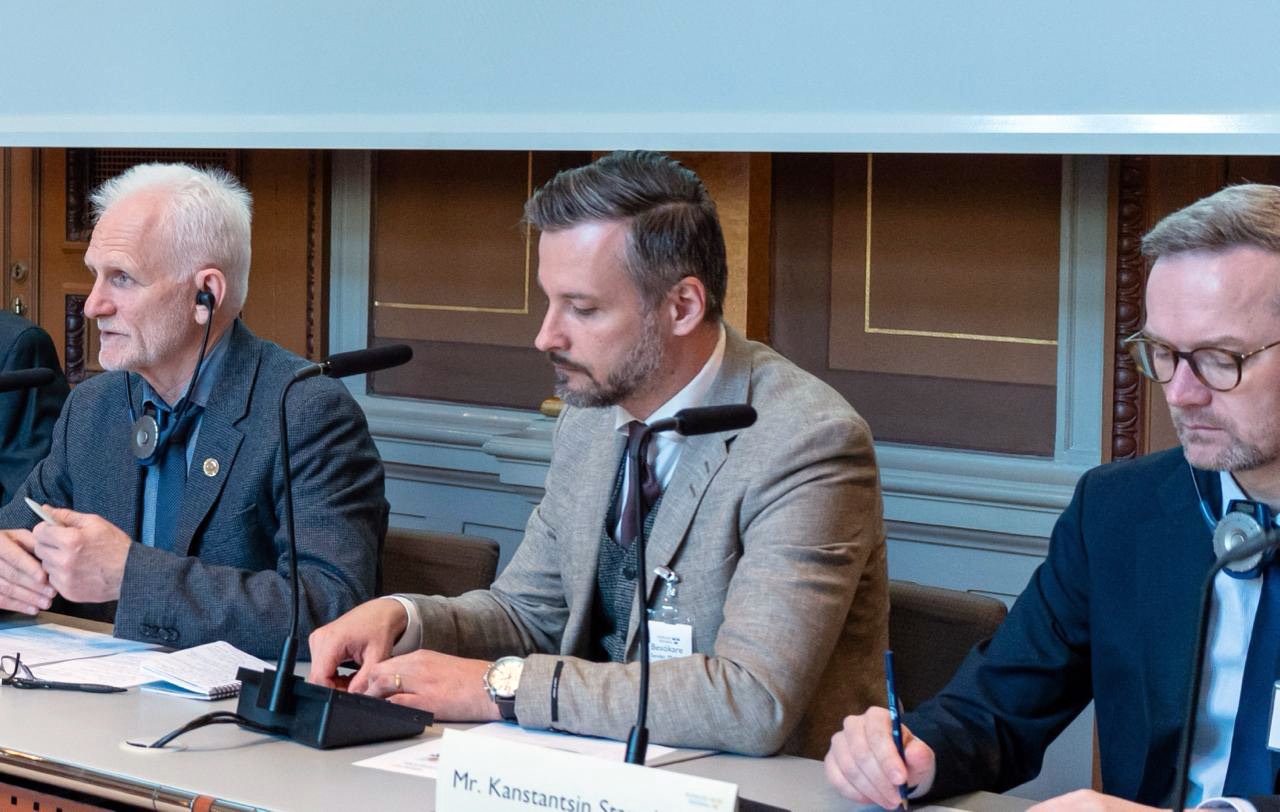
Belarusian human rights defender and Nobel Peace Prize laureate Ales Bialiatski recently visited Sweden, where Michael now lives. The former Kufar director served as interpreter during Bialiatski’s meeting with members of the Riksdag, Sweden’s parliament.
“People contact me from time to time when important guests visit Sweden. I have previously interpreted for Stanislau Shushkevich and Uladzimir Arlou. Apparently there are not many people who speak both Swedish and Belarusian well. It happens perhaps once every few years. Three years ago, when Ales Bialiatski was awarded the Nobel Peace Prize, he was in prison and his wife came to Sweden. I interpreted for her,” Michael says. “This is not voluntary public service. I am paid for it. The money is symbolic, however, and it is not why I do it.”

Michael came away from his conversations with Bialiatski with an overwhelmingly positive impression.
“He has always struck me as a highly cultured and interesting person. I can see that Ales has not been broken, and perhaps he cannot be broken. He continues to fight for what he has always believed in. No matter how many times he is imprisoned, he comes back and insists every time that we are playing the long game and must not give up. Ales Bialiatski never tires of reminding people that, for every political prisoner released, the Lukashenka regime has a habit of creating a new one,” Sender says.
Despite his close contacts with representatives of Belarusian civil society and the opposition, Michael declined offers to work within the country’s democratic movement.
“At one point, I was offered the opportunity to lead something. It was yet another attempt to create some kind of common platform for coordinating action under the auspices of Tsikhanouskaya’s Office. We discussed it, but I declined. At that point, I did not see much value in becoming involved because, to be honest, I did not have much faith in yet another attempt to unite people who had never had any valid reason to be divided in the first place,” he admits.

“Some people developed motives to pull the blanket towards themselves, and no number of conferences will eradicate those motives,” Michael continues. “I would not advise Ms Tsikhanouskaya even to waste time engaging with people who, for the sake of personal ambition, try to manufacture a division that does not really exist. Whatever one may think of Sviatlana, she is objectively Belarus’s only legitimate leader, elected by the majority. Until Belarus holds free and democratic elections, there can be no other leader.
“At the same time, we must understand that carrying this burden is extremely difficult when she has no actual power in Belarus. I attended a meeting between Tsikhanouskaya and the Belarusian diaspora during her recent visit to Stockholm, and I was embarrassed to watch people pester her with consular questions and complaints. It was as though they did not understand that Sviatlana has no legal or diplomatic authority, and that her authority rests on popular support. This is therefore not the time to ask what Tsikhanouskaya can do for you. As John F. Kennedy said, the question is what you can do for her.”
The Secret Life Behind the Anonymous UltraВожык

Another little-known chapter in Michael Sender’s life is his involvement in the anonymous music project UltraВожык. In the mid-2000s, its satirical political songs were highly popular among listeners of Belarusian-language music. In 2005, the rock ballad “Атлантыда” (“Atlantis”) was named one of the season’s best songs by the music website Tuzin Hitou. Sender’s role in the project became public only recently.
“At first, we saw anonymity as an interesting gimmick. We were partly inspired by Gorillaz. Then a narrative built around absurd characters began to emerge almost by itself: Piotr Adamavich, Sabachka Ibrahim and Yauhen Shafa-Uruhvaiski. We simply had enormous fun inventing all this nonsense, and the songs developed in that direction,” Michael recalls.
The project was created with his childhood friend Dmitry Palagin, with whom Michael had been making music since the age of 12, before widespread internet access had reached Belarus.
“We corresponded by sending one another handwritten letters, sheet music and lyrics. We would meet once a year, either when I travelled to Minsk or when he came to Stockholm. In a home studio with dreadful, inexpensive equipment, we made completely incomprehensible things that seemed brilliant to us. UltraВожык emerged as a spontaneous idea. We were sitting on a balcony in Stockholm when one of us said, ‘Why don’t we make something like this tonight? Why overthink it? We’ll throw together some Lukashenka quotations,'” Michael says.
According to Michael, UltraВожык was always more of a spoof than a serious political statement. The group’s first track combined a collection of Lukashenka quotations with a dance version of the national anthem. At the same time, the quality of the group’s music stood out markedly from the alternative scene of the period.
“Everything is relative. If you look at what appeared in the Tuzin Hitou chart at the time, it was mostly punk or garage rock. Stylistically, those genres do not demand highly polished production. We were probably aiming for mainstream technical quality without making vulgar pop music,” Sender explains.

Despite its polished sound, the project remained a source of entertainment for its creators.
“Unlike other niche Belarusian alternative projects, UltraВожык was always an unconventional blend of satire and outright absurdity. Sometimes there was a political subtext, and sometimes we simply wanted to make fun of everyone. We did not take it as seriously as our main band, Dreamgale. UltraВожык was always a secondary project for us. We did not agonise over it. It was purely for entertainment and as a creative warm-up,” Sender says.
Yet it was the unserious side project UltraВожык that gained recognition. Dreamgale, the musicians’ principal project, never really took off, and its only album was, by Michael’s own admission, a complete fiasco. He sees in this the irony of perfectionism.
“With UltraВожык, we genuinely did not worry about quality. With Dreamgale, we worried about it a great deal. Sometimes, by obsessing over something, you simply ruin it and make everything worse. Listening to those songs today, I realise that we should have kept things simpler. With UltraВожык, we got it just right,” he concludes.
Disillusionment with Humanity
While working at Kufar, Michael started a political blog called Antimif. He says that he initially wanted to reach the segment of Russian-speaking society most susceptible to Kremlin narratives. Over time, however, he became disillusioned.
“I realised that my audience increasingly consisted of people who already agreed with me. The people whose minds I wanted to change were not particularly open to changing them. When the events in Crimea began, it became clear that there was an ideological and cultural divide, and Antimif could not bridge it. It was extremely difficult. I simply grew tired of fighting with fanatics who constantly attacked and insulted me,” Michael explains.

Michael channelled his disappointment with humanity into the satirical X account Aliens About Humans. At its peak, the account had more than 100,000 followers and was later turned into a book. He is now preparing a new and more serious project: a blog about society’s future in the age of artificial intelligence.
“The world as we know it does not seem likely to last. We do not know how many years remain before the entire socioeconomic system in which we live becomes incompatible with reality. We are moving rapidly towards a world in which human labour is neither needed nor, to a great extent, meaningful. Under those conditions, the market economy and capitalism, built on the exploitation of labour and consumption, simply collapse.
“Humanity has never been closer to complete collapse. Yet I see a glimmer of hope within this cataclysm. If we stop clinging to familiar approaches, humanity has a rare opportunity to build a world of boundless prosperity and freedom for everyone – a world in which work is not necessary for happiness.
“I want to encourage people to begin that conversation, starting with the problems and challenges. I want it to involve people who are interested and who have ideas, so that perhaps we can find a new model that does not turn humanity into a concentration camp,” Michael Sender says of his plans.
Read the original article in Russian on Zerkalo.